
From AI Assistants to AI Agents: What Enterprises Need to Get Right
AI adoption is entering a more consequential phase. The question is no longer whether a model can answer an employee’s question, but whether an AI system can complete useful work: reliably, securely, and with appropriate human control.
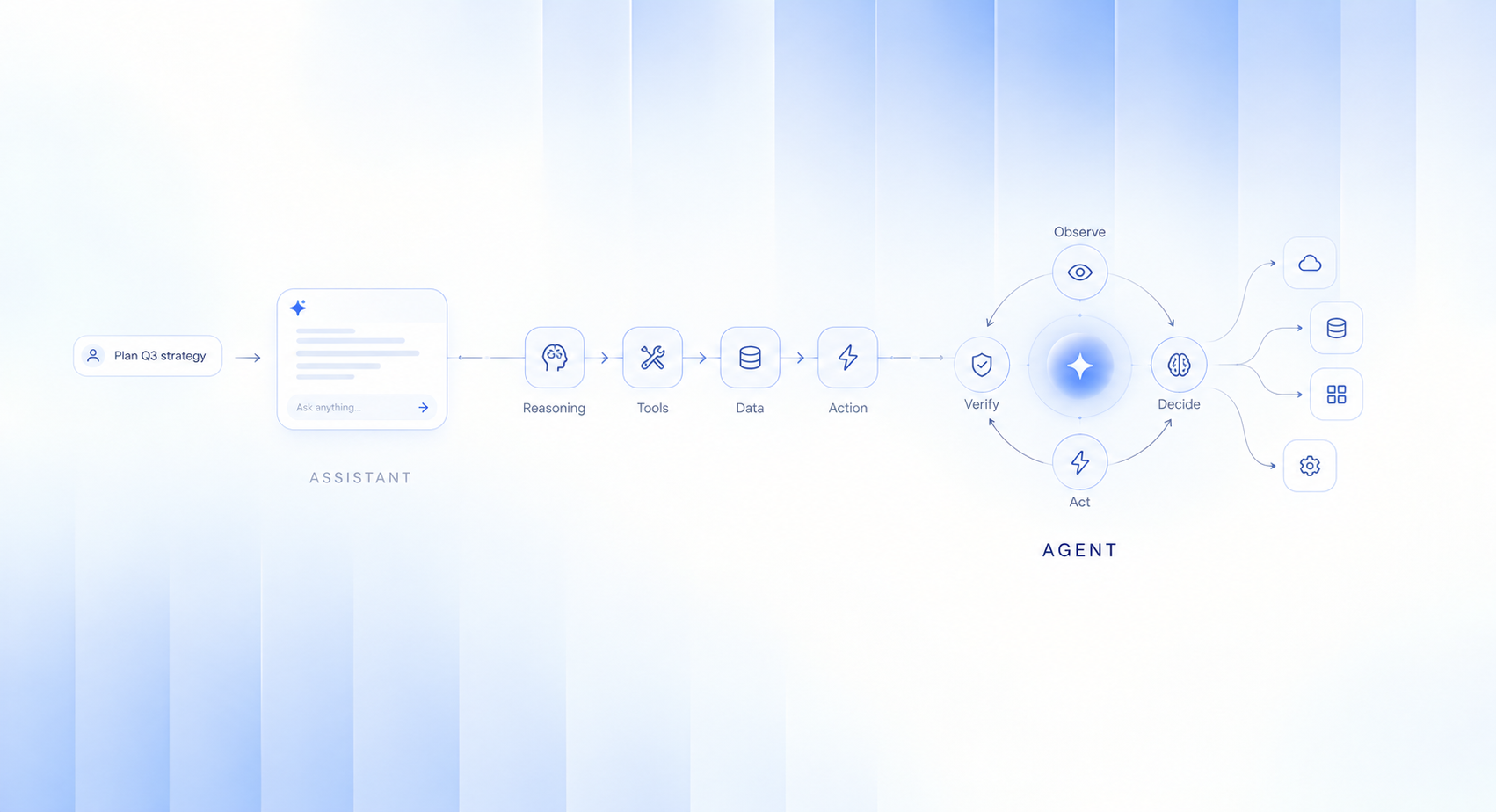
The next step is not a better chatbot
The first wave of enterprise generative AI focused on assistance. Employees could summarize documents, draft emails, retrieve policies, generate code, and explore ideas faster. These tools created value because they reduced the effort required to move from a blank page to a useful first draft.
AI agents raise the stakes.
An assistant helps a person perform a task. An agent can plan a sequence of steps, use enterprise tools, make bounded decisions, and act on the user's behalf. A customer-service assistant might suggest a response. A customer-service agent might verify the customer's identity, review order history, issue a refund within policy, update the case, and send a confirmation.
- Reads the ticket
- Suggests a reply
- A person checks it, edits it, sends it
- Nothing in the business changes until a human acts
- Verifies the customer’s identity
- Reviews order history
- Issues a refund within policy
- Updates the case and sends confirmation
That transition, from generating content to changing business state, is where the real opportunity begins. It is also where weak controls, fragmented data, unclear ownership, and poorly designed processes become much more dangerous.
Enterprises should therefore resist treating agents as assistants with more permissions. An agent is a new kind of digital operator. It needs an explicit mandate, controlled access, measurable performance, and a clear place in the operating model.
What changes when AI can take action
Three things distinguish enterprise agents from traditional assistants.
First, agents are goal-oriented. They do not simply answer one prompt; they work toward an outcome across multiple steps. Second, they are connected. They can read from and write to systems such as CRM, ERP, ticketing, data platforms, and collaboration tools. Third, they operate with some degree of autonomy. They may decide what information to gather, which tool to use, and what step to take next.
These capabilities compound value, and risk. A flawed answer in a chat window can be reviewed and discarded. A flawed action can update a customer record, trigger a payment, expose sensitive data, or disrupt an operational workflow.
The enterprise challenge is not merely to make agents more capable. It is to make their autonomy proportionate to the reliability of the system and the consequence of the task.
The question is not how autonomous an agent can be. It is what level of autonomy this process, this data, and this control environment have earned.
Start with the workflow, not the model
Many AI initiatives begin with a model demonstration and search for a business problem afterward. Agent initiatives should begin in the opposite direction.
The best early use cases usually have four characteristics:
- The workflow is frequent enough for improvements to matter.
- The desired outcome and business rules can be defined clearly.
- The agent can access the information required to do the work.
- Mistakes are detectable and recoverable.
Examples might include resolving routine IT requests, preparing a sales account brief, reconciling standard invoice exceptions, triaging security alerts, or gathering evidence for a compliance review.
Before building anything, map the current workflow. Identify the decisions, systems, handoffs, exceptions, approval points, and failure paths. Then decide which steps should be automated, which should be assisted, and which must remain human-led.
This prevents a common mistake: automating a fragmented process and calling the result transformation.
Build bounded autonomy by design
Enterprise autonomy should not be binary. It should expand in controlled stages.
A useful progression is:
- Observe: The agent gathers information and recommends an action.
- Prepare: The agent creates the proposed transaction but cannot submit it.
- Act with approval: The agent executes only after a person confirms.
- Act within limits: The agent executes independently inside defined thresholds.
- Handle exceptions: The agent manages increasingly complex cases, while escalating uncertainty or policy conflicts.
The right level depends on the impact of an error. Updating an internal knowledge tag and approving a large supplier payment should never have the same control model.
Every agent should have an explicit action boundary: what it may access, which actions it may take, the limits attached to those actions, when approval is required, and when the agent must stop. These rules should be enforced by the surrounding system, not entrusted to a prompt alone.
Treat context as enterprise infrastructure
Agents are only as useful as the context they can access. Yet enterprise knowledge is often scattered across documents, databases, applications, messages, and undocumented human experience.
Connecting an agent to more data does not automatically make it better. Context must be relevant, current, authorized, and traceable. The system needs to know which source is authoritative, which version is valid, and whether the requesting user is permitted to see it.
This requires more than retrieval technology. It requires data ownership, metadata, access controls, knowledge lifecycle management, and a method for grounding actions in trusted sources.
An effective context layer should answer four questions:
- What information does the agent need for this task?
- Which systems are authoritative for that information?
- What is the user, and therefore the agent, allowed to access?
- How can the source and reasoning trail be inspected later?
Without this foundation, agents may appear intelligent while operating on stale or contradictory information.
Design tools for machines, not just people
Enterprise applications were built for humans navigating screens. Agents work best with narrowly defined tools and predictable interfaces.
Instead of giving an agent broad, unrestricted access to an application, expose specific capabilities such as "retrieve open invoices," "draft a refund," or "update case status." Each tool should validate inputs, enforce permissions, return structured results, and produce an audit record.
This architecture creates a crucial separation of responsibilities. The agent can decide which approved capability to invoke, while the tool layer enforces what is actually allowed. If the model makes a poor decision, the transaction boundary still protects the business.
Evaluate outcomes, not impressive conversations
A smooth demonstration is not evidence that an agent is ready for production.
Agents must be tested across the full workflow, including ambiguous requests, missing data, conflicting instructions, tool failures, permission boundaries, and unusual exceptions. Evaluation should combine technical and business measures.
Useful measures include:
- Task completion rate
- Accuracy of decisions and actions
- Policy-compliance rate
- Correct escalation rate
- Time and cost per completed task
- Number of actions reversed or corrected
- User trust and adoption
- Business impact, such as resolution time or exception backlog
Evaluation should continue after deployment. Models change, source data changes, integrations fail, and business policies evolve. Production monitoring is therefore part of the product, not a final operational handoff.
Make governance part of the architecture
Agent governance cannot depend on a review committee examining every use case manually. Governance must be translated into reusable technical controls and operating standards.
Enterprises need, at minimum, a registry of agents and owners; risk classification by use case; identity and least-privilege access; action logs; approval policies; data-handling rules; incident procedures; and a reliable way to suspend an agent.
Ownership should also be explicit. The business owner is accountable for the outcome. Technology teams are accountable for the platform and integrations. Security, risk, legal, and compliance define guardrails. Human operators help define exceptions and validate whether the workflow works in practice.
This shared model is important because an agent is neither just software nor just a workforce tool. It sits between both.
Redesign work around human-agent teams
The largest gains will not come from inserting agents into every existing step. They will come from redesigning how work flows between people and machines.
Agents are well suited to high-volume coordination, information gathering, routine execution, and continuous monitoring. People remain essential where work requires judgment, empathy, accountability, negotiation, or decisions under genuine ambiguity.
That division should shape roles, training, and performance management. Employees need to understand what the agent can do, how to review its work, and when to intervene. Managers need visibility into both human and agent performance. Process owners need the authority to redesign workflows rather than simply add another tool.
If adoption is framed only as "using AI," employees may see an optional productivity feature. If it is embedded in a better operating process, it becomes part of how the organization delivers outcomes.
A pragmatic path to production
Enterprises can move quickly without making uncontrolled bets.
Choose one bounded workflow. Select a meaningful process with measurable pain, accessible data, and recoverable errors.
Define the operating contract. Specify the goal, inputs, allowed tools, decision limits, approval points, escalation rules, and success measures.
Run in observation mode. Let the agent recommend actions while humans continue to execute. Compare its performance with real outcomes.
Introduce controlled action. Allow low-risk execution with approvals, then increase autonomy only when evidence supports it.
Scale the reusable foundation. Standardize identity, tool interfaces, monitoring, evaluation, governance, and lifecycle management so that each new agent does not become a one-off project.
The real advantage is operational maturity
The winning enterprises will not necessarily be those with the most agents. They will be those that can deploy useful agents repeatedly, connect them to trusted context, constrain their authority, measure their outcomes, and improve them safely.
AI assistants changed how employees create information. AI agents will change how organizations execute work. That is a far more significant shift, and it demands far more than a clever model.
The essential question is not, "How autonomous can this agent be?" It is, "What level of autonomy has this process, this data, and this control environment earned?"
Conclusion
Moving from an assistant that suggests to an agent that acts is less about finding a smarter model and more about the scaffolding you build around it: a well-bounded workflow, real context, and governance that's part of the architecture rather than bolted on afterward. The enterprises that get this right aren't chasing the most capable model; they're disciplined about where autonomy has actually been earned.
- Start narrow: pick one workflow with clear boundaries before granting any agent wider autonomy.
- Judge agents by outcomes and recoverability, not by how convincing the conversation sounds.
- Build governance and a human checkpoint into the architecture from day one, not as a patch later.
If you're weighing where an agent could safely take over a workflow and where a person still needs to stay in the loop, we're happy to think it through with you. Book a call, no pitch, just an honest read on what's ready and what isn't yet.