
Why Modern Data Platforms Need DataOps, Not Just Pipelines
Moving data is only the beginning. A modern data platform creates lasting value when teams can change it safely, trust its outputs, and operate it as a dependable product.
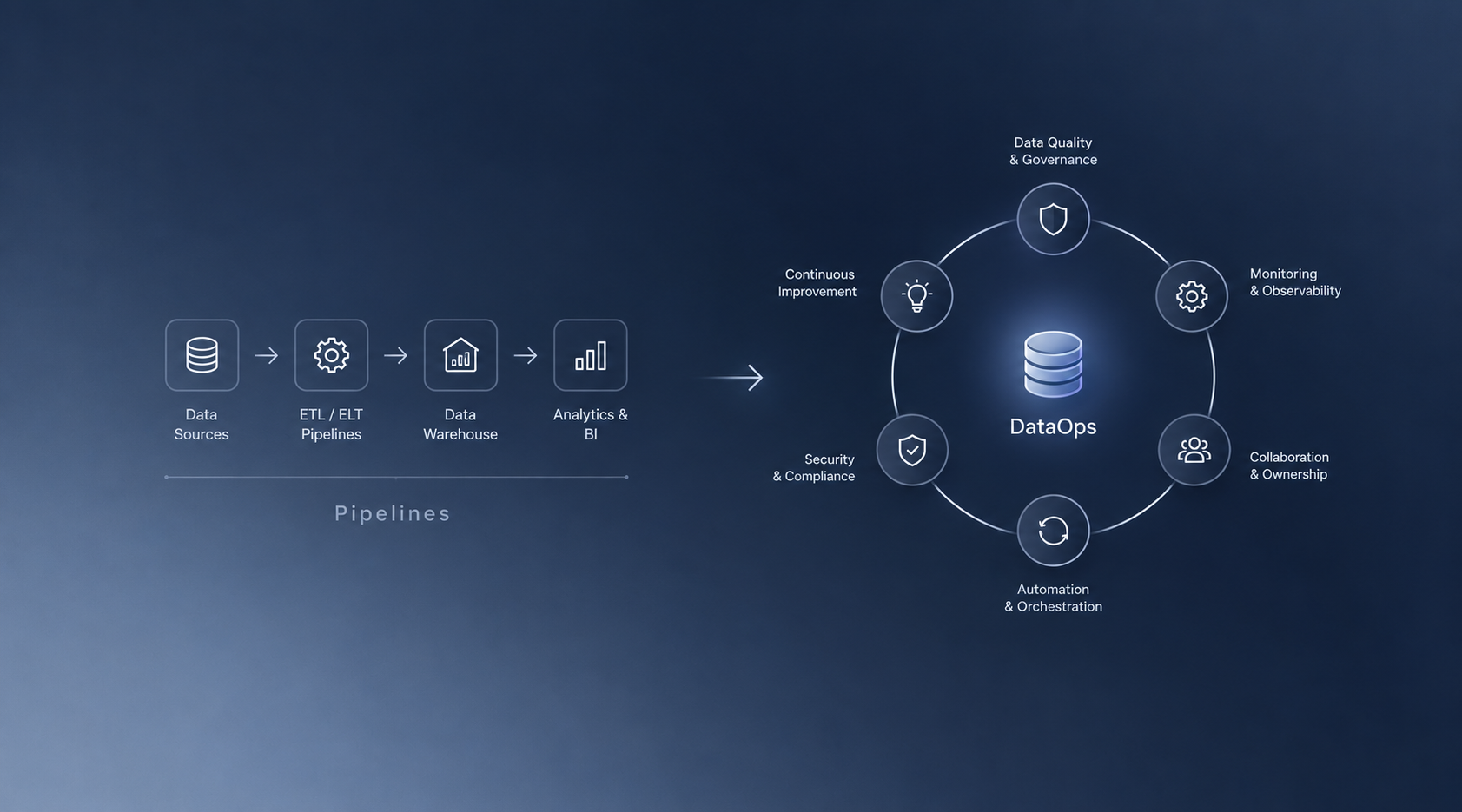
A pipeline can run successfully and still fail the business
For years, building a data platform often meant building pipelines: extract data from source systems, transform it, load it into a warehouse or lakehouse, and make it available for reporting.
That work remains essential. But it is no longer sufficient.
A pipeline can complete on schedule while delivering incomplete data. A dashboard can refresh while using a definition that changed upstream. A machine-learning feature can pass technical checks while drifting away from the real-world behavior it is meant to represent. A new field can silently break downstream logic. Two teams can publish conflicting versions of the same metric, and both can be technically correct according to their own assumptions.
These are not simply pipeline problems. They are operating-model problems.
A pipeline can run successfully and still fail the business.
Modern data platforms sit at the center of reporting, digital products, automation, regulatory processes, and AI. As their influence grows, organizations need a disciplined way to develop, release, observe, govern, and improve data products. That discipline is DataOps.
What DataOps actually means
DataOps is sometimes reduced to "DevOps for data." The comparison is useful, but incomplete.
Like DevOps, DataOps emphasizes automation, version control, testing, continuous delivery, observability, and collaboration. But data introduces a distinctive challenge: the product can change even when the code does not.
Source systems evolve. Business behavior shifts. Records arrive late. Definitions change. Data quality can vary by geography, channel, or time period. The same transformation code can produce a very different business result from one day to the next.
DataOps therefore manages three connected forms of change:
- Code change: transformations, models, orchestration, and infrastructure
- Data change: schema, volume, distribution, timeliness, and quality
- Meaning change: business definitions, ownership, policy, and intended use
product
A mature DataOps practice makes all three visible and manageable.
Pipelines optimize movement; DataOps optimizes outcomes
Pipeline-centric teams naturally focus on whether jobs completed, records moved, and service-level targets were met. Those signals matter, but they do not answer the question consumers actually care about: "Can I trust and use this data?"
DataOps expands the unit of management from a technical workflow to a data product. A data product may include datasets, transformations, definitions, documentation, quality rules, access policies, lineage, ownership, and a service expectation for its consumers.
This shift changes the conversation.
Instead of asking only whether the customer-revenue pipeline ran, the team asks whether the customer-revenue product is current, complete, correctly defined, discoverable, secure, and fit for the decisions it supports.
That is a higher standard, and the standard modern enterprises increasingly require.
- Did the job complete?
- How many records moved?
- Did we hit the SLA?
- Who owns the code?
- Is the customer-revenue product current and complete?
- Is the definition correct and discoverable?
- Is it secure and fit for the decisions it supports?
- Who owns the outcome?
The six capabilities of effective DataOps
1. Versioned, automated delivery
Data transformations, infrastructure definitions, quality rules, and configuration should be version-controlled. Changes should move through repeatable development, test, and production environments, with automated checks and approval rules appropriate to their risk.
This reduces manual variation and makes changes easier to review, reproduce, and reverse. It also creates a visible history of who changed what and why.
2. Testing across code, data, and meaning
Traditional software tests validate expected behavior from controlled inputs. Data testing must work in a less predictable environment.
Teams need several layers of protection: schema and contract checks, transformation tests, reconciliation against sources, quality thresholds, business-rule validation, and regression checks for critical metrics.
Not every anomaly is an error. A spike in orders might reflect a successful promotion. The purpose of testing is not to force data into a static shape, but to identify changes that require explanation before consumers are affected.
3. End-to-end observability
Pipeline monitoring tells teams whether a job failed. Data observability should reveal whether a data product is healthy.
That includes freshness, volume, distribution, schema, lineage, quality, and usage. It should connect an upstream change to the dashboards, models, applications, and decisions that depend on it.
Without lineage and impact analysis, incident response becomes detective work. With them, teams can identify affected consumers, prioritize remediation, and communicate clearly.
4. Explicit ownership and service expectations
Every important data product needs an accountable owner. Ownership means more than being listed in a catalog. The owner should understand the consumers, definitions, quality expectations, access requirements, and consequences of failure.
Service expectations should reflect business need. A real-time fraud signal and a weekly workforce report do not require the same freshness or recovery target. DataOps makes those differences explicit so that engineering effort follows business criticality.
5. Governance embedded in delivery
When governance is applied only through periodic reviews and manual approvals, it becomes slow, inconsistent, and easy to bypass.
DataOps turns policy into workflow. Classification, access control, retention, masking, lineage, and approval requirements can be enforced as part of building and releasing a data product.
This does not remove human judgment. It directs human attention toward exceptions and high-risk decisions while automating routine controls.
6. Fast feedback from consumers
Data platforms often accumulate unused datasets because success is measured by production deployment rather than adoption and impact.
DataOps closes the loop between producers and consumers. Usage patterns, support requests, quality incidents, and business feedback inform the product backlog. Teams can see which assets are trusted, which are duplicated, and which should be improved or retired.
DataOps is an operating model, not a tool purchase
Organizations sometimes respond to reliability problems by buying another monitoring platform, catalog, or orchestration tool. Technology can help, but it cannot establish accountability or collaboration on its own.
DataOps requires a working relationship among data engineering, analytics, platform engineering, governance, security, and business teams. The exact structure will vary, but responsibilities should be clear.
Platform teams provide reusable capabilities and paved roads. Domain teams own the meaning and fitness of their data products. Governance and security teams define policies that can be embedded into those roads. Consumers contribute requirements and feedback.
The central platform should make the safe, observable, and well-governed path the easiest path. If every team must assemble its own deployment process, quality framework, metadata standards, and monitoring stack, the organization will scale inconsistency rather than value.
Common anti-patterns to avoid
Several patterns signal that a platform has pipelines but not DataOps.
Success is defined as "the job ran." Technical completion is treated as proof that data is trustworthy.
Quality is checked at the end. Teams discover issues in executive dashboards instead of detecting them near the source.
Nobody owns the data product. Engineering owns the code, the business owns the definition, and incidents fall into the gap between them.
Every change is a ticket. Manual handoffs make delivery slow and encourage workarounds.
Governance is separate from engineering. Policies exist in documents but are not enforced in the delivery workflow.
More data is assumed to mean more value. Teams create assets faster than consumers can discover, trust, or use them.
Recognizing these patterns is useful because the remedy is rarely "build another pipeline."
How to introduce DataOps without a major reorganization
DataOps can begin with a small number of high-value data products.
First, identify a business-critical dataset or metric with recurring reliability or change-management problems. Name an accountable owner and document its consumers, sources, definitions, service expectations, and risk profile.
Next, map how changes reach production. Add version control, automated testing, peer review, and environment promotion where gaps exist. Define a small set of quality signals that reflect actual consumer needs.
Then instrument the product end to end. Monitor freshness and quality, capture lineage, route incidents to the right owner, and communicate impact to consumers.
Finally, turn what works into a reusable platform pattern. Templates, standard checks, policy-as-code, common metadata, and self-service tooling allow other teams to adopt the model without reinventing it.
The objective is not to create a perfect framework before delivery. It is to improve the reliability and speed of a real product, learn from it, and scale the practice deliberately.
Measure what the platform enables
Infrastructure metrics alone do not show whether DataOps is working. A balanced scorecard should include operational, delivery, adoption, and business measures.
Examples include:
- Time from approved change to production
- Percentage of changes covered by automated tests
- Data incidents detected before consumer impact
- Mean time to identify and recover from incidents
- Percentage of critical products with owners and service expectations
- Usage and reuse of certified data products
- Duplicate or obsolete assets retired
- Consumer trust and satisfaction
The right metrics reinforce a simple principle: the purpose of the platform is not to move the maximum amount of data. It is to help the organization use data confidently and efficiently.
Reliability is the feature that makes every other feature valuable
Modern architectures (cloud warehouses, lakehouses, streaming platforms, data meshes, and AI stacks) can all expand what an enterprise can do with data. But architectural sophistication does not guarantee operational maturity.
Pipelines make data available. DataOps makes data dependable, changeable, governable, and useful at scale.
That difference matters because every dashboard, automated decision, and AI application inherits the strengths and weaknesses of the data beneath it. When data becomes part of how the business operates, DataOps is no longer an engineering preference. It is a business capability.
Conclusion
A pipeline that runs on schedule isn't the same as a platform people actually trust. DataOps is what closes that gap: not a tool you buy, but an operating model built on ownership, observability and steady, unglamorous reliability. Getting there doesn't take a reorg on day one; it takes picking the capability that's hurting you most right now and building from there.
- Start with observability and ownership: you can't fix what nobody is accountable for.
- Measure what the platform enables (trust, adoption, time-to-insight), not just uptime.
- Introduce DataOps one capability at a time, not as a single big-bang rollout.
If you're trying to work out which capability would move the needle first for your team, we're glad to think it through with you. Book a call, no pitch, just an honest look at where the platform is actually losing people's trust.